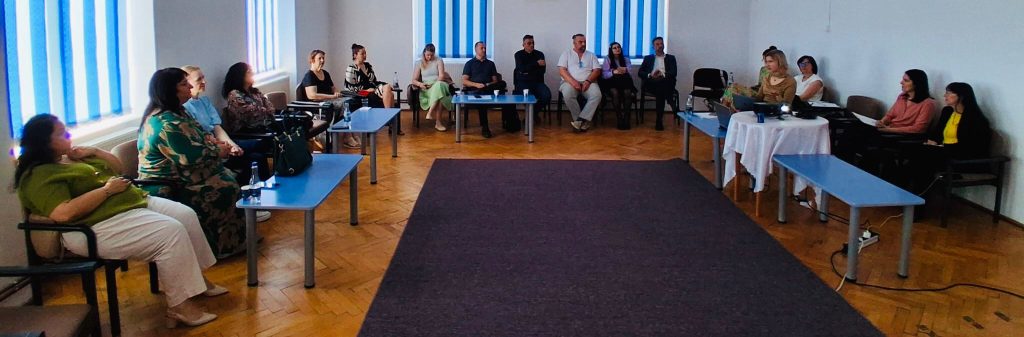
Local working group meeting in Sibiu under the project “From Education to Decent Work”
Local working group meeting in Sibiu under the project “From Education to Decent Work”
Last week, in Sibiu, CRPE facilitated a new meeting of the local working group organized under the project “From Education to Decent Work”, coordinated by Fundația HEKS/EPER România.
The discussions focused, on the one hand, on evaluating technological high schools and the need to recalibrate performance indicators for vocational education and training. On the other hand, the meeting highlighted a number of concrete challenges, drawn directly from the experience of schools and economic partners.
One key issue was the rigidity of the system when schools try to adapt their offer to the labor market. Authorizing a single new qualification can cost a school more than 12,000 RON, while accreditation requires an additional approximately 19,000 RON, all covered from per-student funding. In practice, many schools cannot afford to become relevant to the local economy without substantial financial support from local authorities.
Another important theme was the need for real educational reorientation mechanisms for students who realize that the chosen specialization is not the right fit. In the policy brief “Preventing School and Professional Dropout in Vocational and Technical Education in Romania”, CRPE analyzed examples from other European countries that treat educational pathway changes as a natural process, not as a failure. In some regions, young people at risk of dropout can take part in training-centre type programmes, where they can test several trades over a short period before deciding on the qualification they will pursue. In France, the Second Chance Schools combine counseling, successive company internships and individual mentoring to help young people find an educational and professional path that suits them.
Participants noted that in Romania, a student assigned to a specialization that does not fit has very few opportunities to explore alternatives before dropping out or accumulating school failure. In the context of the ongoing transformation of the technological track, developing mechanisms for trade exploration and educational reorientation could become an important component of dropout prevention.
The conclusion is clear: we need more investment and more flexibility. Schools must be financially supported to adapt their offer to economic needs, and students must have access to real educational reorientation mechanisms.